



TODAY'S TAKEAWAY
Be a reverse mentor.
Just because someone is high up doesn't mean they have all the answers. Share your ideas, no matter your job title. You might surprised at how little the senior people know.
THE STORY
An insurance company CEO with a problem
It was 2013. Liam E. McGee, CEO of The Hartford, a Fortune 500 insurance company that protects over 1 million small businesses, had a realization.
His leadership team was experienced and accomplished—but out of touch.
McGee believed that his senior leaders needed to "become more fluent in social media, mobile computing, the cloud, and other digital technologies"—all technologies their customers, partners, and competitors were using.
The problem? The people who understood these technologies best weren't the higher-ups who only grasped these ideas theoretically, but the folks actually doing the work practically.
So McGee made an unconventional decision: flip mentorship upside down.
He implemented a "reverse mentoring program" where "the young, technologically savvy staff would share their knowledge of social media with The Hartford's senior staff."
What happened when 50 junior employees started mentoring 50 senior executives?
- 97% of senior executives (mentees) rated the program "extremely effective"
- 11 of 12 juniors (mentors) in the first group were promoted within 1 year
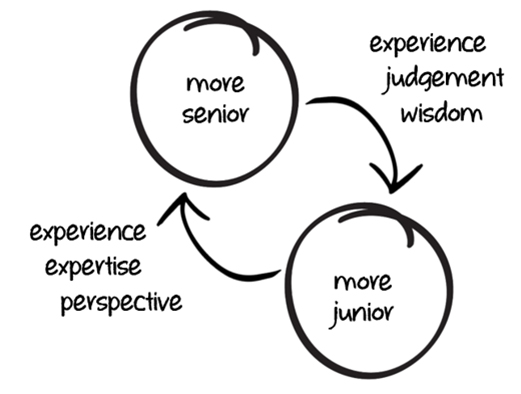
Fast forward to 2026 (13 years since The Hartford's program), and reverse mentoring has spread to companies worldwide.
Take Coca-Cola in Vietnam, for example. Gen Z staff were paired with senior leaders—including former Vietnam CEO Peeyush Sharma—to share their ideas and trending tech tools.
Other companies that have launched reverse mentoring programs include P&G Baby Care Product Supply, PwC, Mars, Cisco, and Microsoft.

THE UNSPOKEN RULE
Don't wait for your turn to lead
Here's what I learned from these reverse mentoring programs and from the hundreds of conversations I've had with senior leaders: The higher up someone is in an organization, the higher level their perspective is, too.
The result?
They don't necessarily know how things actually work—and they definitely don't know about all the "skeletons in the closet" (defined here).
What does this mean for the rest of us who aren't the CEO or the SVP?
The next time you find yourself sinking into your chair in the face of someone more senior, try completing this sentence:
- "This other person might be more senior, but their seniority could also mean that they are not as close to [this / trend / tool / detail]. I can be valuable by sharing [this experience / observation]."
For example:
- "This person might be more senior, but their seniority could also mean that they are less close to understanding why customers are objecting to our sales pitches. I can be valuable by sharing the patterns I've observed in client calls that didn't go well and what we could change about our offering to shorten our sales cycle."
Speaking up doesn't just help senior leaders, either—it demonstrates your own Three C's to the decision-makers and gatekeepers who could pull you up (the ranks) and in (to unadvertised opportunities).
My last word of advice: this tactic goes both ways!
If you’re the more senior person on a team of juniors, remember that you’ve got a wealth of institutional knowledge (and your juniors may not even realize how beneficial this insight truly is). Share some experiences and observations of your own, and you may be surprised at how open they are to learning from you.
See you next Tuesday for our next story and unspoken rule,
Gorick
WHAT I'M READING
Here are 3 articles that I found interesting recently (no paywalls, although it may depend on your cookies):
- “In Praise of Being First-Gen” (Inside Higher Ed)
- “The Great Re-education: Why over-40s like me are quitting careers and heading back to school” (Independent)
- “Here’s What Happens to Your Brain When Your Mind Goes Blank” (Nautilus)
MORE OF MY WORK
Every newsletter is free and a fraction of my work. Here are 3 of my paid offerings that may interest you:
1. Keynote speaking: If your organization is looking for speakers for your internship program, new hire orientation, new student orientation, manager training, all-hands meetings, recruiting season, year-end performance evaluation season, or something else, let's chat!
2. How to Say It: Flashcards that teach you to know what to say in every high-stakes professional setting via hundreds of fill-in-the-blank scripts (just like the examples above). Free shipping on all orders over $40.
3. The Unspoken Rules: My Wall Street Journal Bestseller that Arianna Huffington calls “a blueprint for anyone starting their career, entering a new role, or wanting to get unstuck.” Used by top companies and MBA programs.
4. Soft skills crash course: Hard skills get you hired, but a lack of soft skills gets you fired. Equip your interns and early career talent with the essential behaviors of high performers in just 3.5 hours.
STORY SOURCES


