


Given that the Oscars just happened over the weekend, I thought I'd revive one of my favorite career stories from my newsletter archive on the "unspoken rule" of getting an Oscar—and what we can all learn for our careers and lives.
Enjoy!
Gorick
TODAY’S TAKEAWAY
Being memorable matters.
So make yourself visible, show your work, and don’t let others forget your value.
THE STORY
What Oscar award winners (and losers) have to teach us about being memorable
Two days ago, 20 million people tuned in for Hollywood’s “biggest night”: the Academy Awards, also known as the Oscars.
Every year, nominees across 22 categories compete for “the most prestigious awards in the entertainment industry,” from “Best Actor” to “Best Original Score.”
The system is simple: whoever gets the most votes wins.
Who gets to vote? Members of the Academy of Motion Picture Arts and Sciences.
Presumably, the best of the best wins… right?
Not necessarily.

So, who has a better shot at winning? Films released towards the end of the year—and therefore right before voting begins.
The data doesn’t lie: the vast majority of Oscar-nominated films are released in September, October, November, and especially December (as shown in the lighter green regions in the chart below).
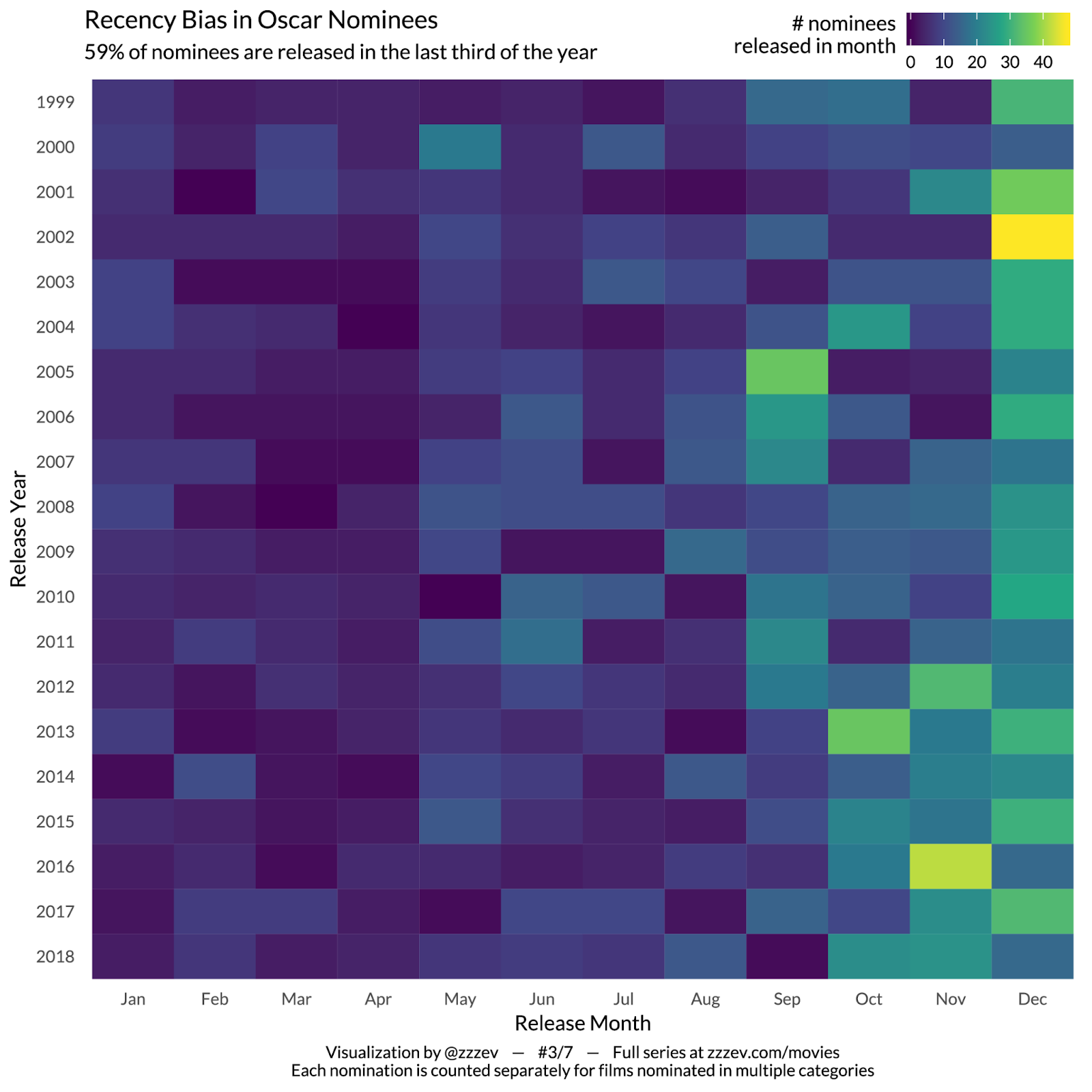
Psychologists even have a term for this: recency bias, or the “tendency to place greater weight” on more recent events.
(This bias explains a host of things in life. This is why it’s easier to remember items at the end of a list over items at the beginning of a list!)
“But what if,” you ask, “Movie studios secretly know which movies have the potential to win the Oscars—and wait until the end of the year to release them?”
This “unspoken rule” of winning the Oscars is really an open secret. Hollywood even has terms to explain the games that studios play:
- When are blockbuster epics (aka “Oscar Bait”) released? Towards the latter half and end of the year, to stay fresh in the viewers’ minds.
- When are low-budget movies with lower expectations released? During the “Dump Months” of January and February, when audiences are more likely to forget by the following year.
Fast forward to this past Sunday, March 15, 2026, and the 98th Oscars reinforced this trend: 6 of the 7 films that won major awards were released in the second half of 2025 or January 2026 (right before the cutoff). There was one exception: Sinners, released in April of 2025, which won 3 awards.
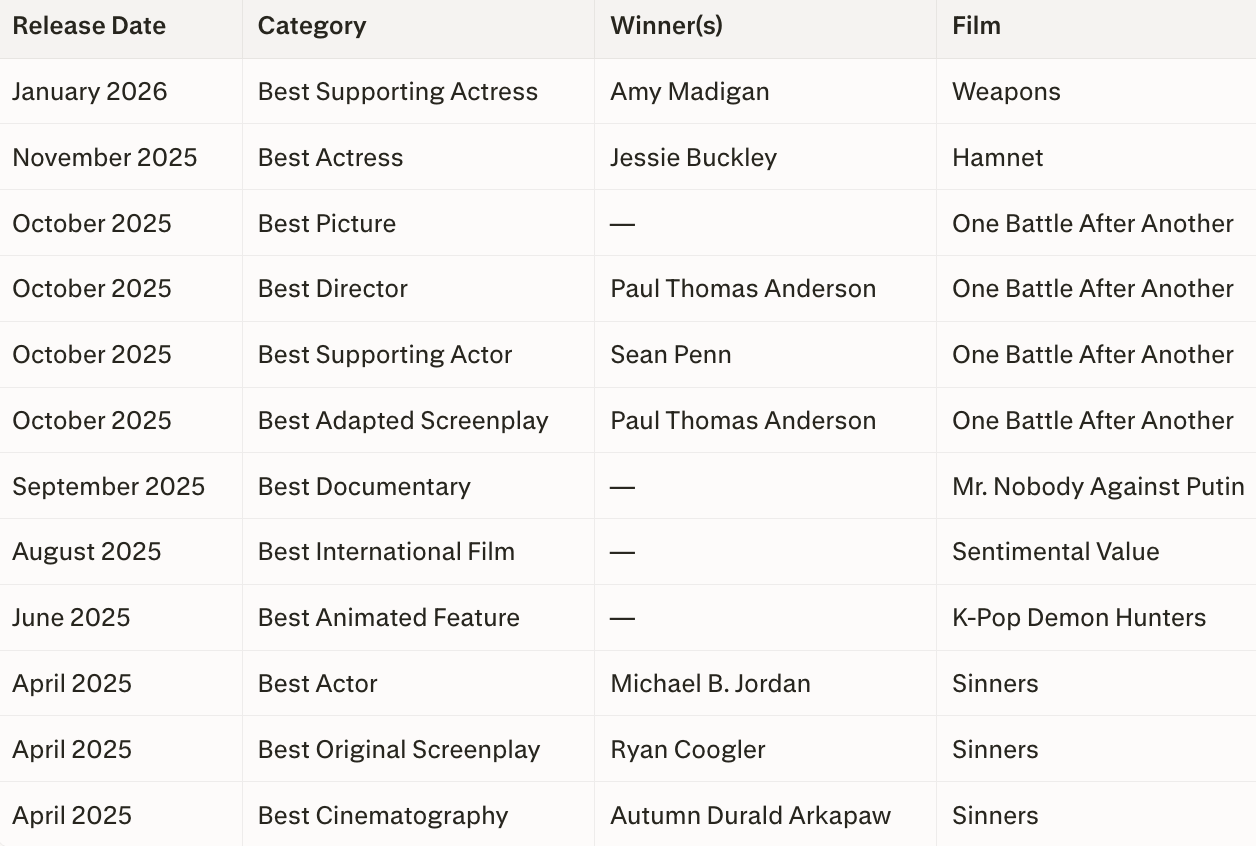
Winners of the top 12 Oscar Awards in 2026. Notice the trend under the "Release Date" column?
So, the next time you see an Oscar-nominated or Oscar-winning film, it’s time to ask yourself, “Did this movie win because of great acting, directing, costumes, visual effects, etc., or did it win because it had the right strategy?”
THE UNSPOKEN RULE
Being remembered matters—in Hollywood and in your career.
Hollywood isn’t the only place where recency bias exists. It’s true in every workplace.
That year-end performance evaluation? Your manager will be thinking about your most recent performance—while forgetting that heroic effort you pulled off in February.
That promotion or hiring decision? The committee will be advocating for the candidate who demonstrated The 3 C’s most recently and consistently.
The bottom line is: Don’t assume that people will remember what you’ve done or even who you are. Remind people at every turn.
Here are just 2 of many everyday workplace situations that people overlook:
1. When you’re introducing yourself
2. When you’re delivering a status update
1. When introducing themselves, most people merely stop at “My name is _______.”
This is a missed opportunity to remind others of what you are working on and, moreover, why you matter.
- Instead, try saying, “My name is _______ and I am a _______ working on _______ whose goal is to _______.”
2. When delivering a status update, most people merely stop at “It’s going well!”
This is also a missed opportunity to remind others of what you are working on and, moreover, why they should care.
- Instead, try saying, “I’m working on _______ where the objective is to _______. So far, I’ve _______ (and discovered / and was surprised to find that _______). As a next step, I will _______.”
People don’t know what you know and can’t read your mind, so if you don’t share, others risk never knowing—and never giving you the credit you deserve.
The more you “exist,” the more likely others will see your potential—and the more likely they are to pull you into the jobs that don’t get posted and meetings that don’t get shared.
See you next Tuesday for our next story and unspoken rule,
Gorick
WHAT I’M READING
Here are 3 articles that I found interesting recently (no paywalls, although it may depend on your cookies):
- That Stressful Person in Your Life Might Be Aging You Faster, Study Finds (US News)
- Lessons from an Early-Career Journalist (Columbia Journalism Review)
- Who benefits from AI? New comic explores technology’s impact on labor (MIT Sloan)
MORE OF MY WORK
1. Keynote speaking: If your organization is looking for speakers for your internship program, new hire orientation, new student orientation, manager training, all-hands meetings, recruiting season, year-end performance evaluation season, or something else, let's chat!
2. HOW TO SAY IT ®: Flashcards that teach you to know what to say in every high-stakes professional setting via hundreds of fill-in-the-blank scripts (just like the examples above). Free shipping on all orders over $40.
3. The Unspoken Rules: My Wall Street Journal Bestseller that Arianna Huffington calls “a blueprint for anyone starting their career, entering a new role, or wanting to get unstuck.” Used by top companies and MBA programs.
4. Soft skills crash course: Hard skills get you hired, but a lack of soft skills gets you fired. Equip your interns and early career talent with the essential behaviors of high performers in just 3.5 hours.
STORY SOURCES
- 20 million people
- “biggest night”
- “the most prestigious awards in the entertainment industry,”
- The 2026 Oscars stage
- The data doesn’t lie
- Recency Bias in Oscar Nominees
- “tendency to place greater weight”
- the items at the end of a list
- blockbuster epics
- “Oscar Bait.”
- “Dump Months”
- often 50% of production costs and sometimes more
- “like Scorsese and De Niro”
- “remarkable dual performance as the Smokestack twins, Smoke and Stack”
- “distinct yet in sync”
- Imax 70MM
- 6 of the 7 films that won major awards were released in the second half of 2025 or January 2026 (right before the cutoff)


